
Brigitte Bönisch-Brednich (Professor of Cultural Anthropology and Director of the Stout Research Centre for New Zealand Studies at Te Herenga Waka—Victoria University of Wellington) has been awarded Honorary Life Membership of the Association of Social Anthropologists of Aotearoa New Zealand. Professor Bönisch-Brednich was nominated for Honorary Life Membership by her colleague, Lorena Gibson, and was unanimously conferred this award at our Annual General Meeting in Whāingaroa (Raglan) during our 2025 annual conference.
Brigitte Bönisch-Brednich was born in Lower Saxony, Germany, the youngest of five surviving children in a family of post-WW2 refugees from Upper Silesia. She studied Cultural Anthropology, Art History, Archaeology and History of Science at the Georg-August University of Göttingen from 1982 to 1987, graduating with an MA in European Ethnology with distinction in 1987. She earned her PhD in Cultural Anthropology from Phillips University Marburg in 1994 with a scholarship from the Immanuel-Kant-Foundation, and was awarded her Dr. habil – the highest university degree you can be awarded in Germany, involving a second dissertation and much more – from the University of Göttingen in 2000 for a project on German migration to New Zealand. She worked on independent research projects and lectured at universities in Germany, Switzerland, and Austria before travelling to Aotearoa New Zealand with her husband, Professor Rolf Brednich, in 1996. Brigitte and Rolf connected with Victoria University of Wellington’s Stout Research Centre for New Zealand Studies, and Brigitte spent a year as a research resident investigating the history of German immigration to New Zealand. She took up a position as associate professor of Cultural Anthropology at Victoria University of Wellington in 2002 and was promoted to full professor in 2007. Her own experience of migration and her family’s history as refugees has profoundly shaped her scholarly engagement with questions of migration, narrative, memory, and belonging in Aotearoa New Zealand.
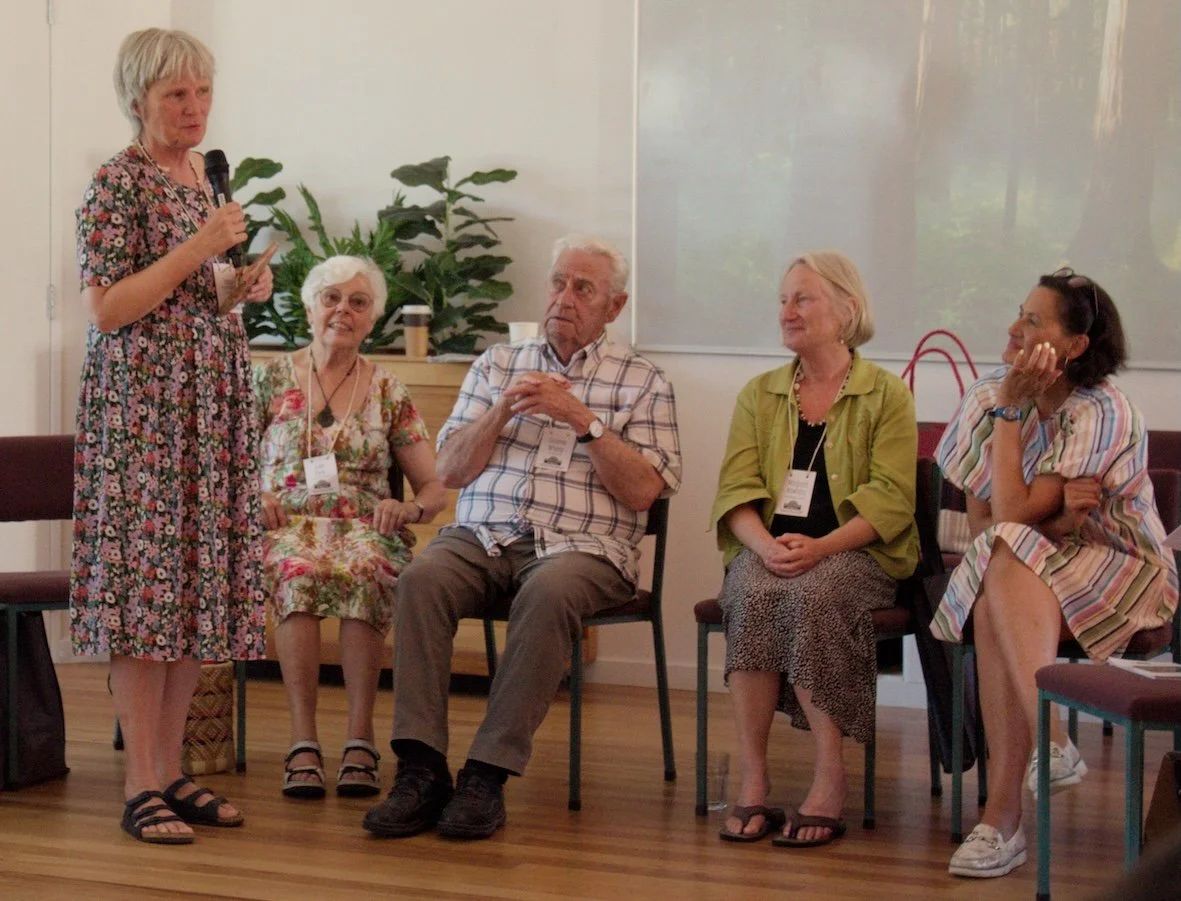
Brigitte Bönisch-Brednich at the ASAA/NZ AGM in Whāingaroa (Raglan) in December 2025, when she was awarded Honorary Life Membership of ASAA/NZ.
Photograph: Ciara Cormac Scott
Throughout her 23-year career (and counting) at Victoria University of Wellington, Brigitte has made exceptional contributions to the institution and to cultural anthropology as a discipline. During a period of staffing change in the decade following her appointment, Brigitte’s leadership was instrumental in transforming the Cultural Anthropology programme into a thriving programme known for its innovative curriculum, collegial culture, and strong student numbers. As well as teaching popular courses on ritual, migration, visual anthropology, and ethnographic-research methods, she has served as Programme Director, Head of the School of Social and Cultural Studies and, since 2022, has been Director of the Stout Research Centre for New Zealand Studies, a position she will hold until 2030. She has been an elected staff representative on the Victoria University Council since 2020, where she has advocated for academic values and institutional integrity during a period of significant challenges to New Zealand’s tertiary-education sector. Her commitment to supporting women in academia is evidenced by her membership in the international network for Women in Higher Education Management (WHEM), and she serves as a reviewer for the German, Swiss, and Austrian governments’ research funds.
Since her arrival at Victoria University of Wellington, Brigitte has been a notably energetic and committed member of ASAA/NZ. As well as presenting at annual conferences – and encouraging all her colleagues and graduate students to do the same – she also served as ASAA/NZ chairperson for nine consecutive years from 2014 to 2023. This period was perhaps one of the most challenging in the history of anthropology in Aotearoa New Zealand, marked by university restructuring, staff reductions, the COVID-19 pandemic, and the increasing corporatisation of universities. Under Brigitte’s leadership, ASAA/NZ navigated these turbulent times with resilience and vision. When the University of Canterbury’s Anthropology programme was reduced to two staff members following Professor Patrick McAllister’s death in 2016, when the University of Otago’s Social Anthropology programme was cut from four to two staff in 2016, and when the University of Waikato faced similar threats, Brigitte worked to support colleagues and advocate for the discipline.
During her tenure as chairperson, Brigitte oversaw the introduction of numerous initiatives that enhanced ASAA/NZ’s role in supporting members and promoting the discipline, including the Dr Cyril Timo Schäfer Memorial Graduate Student Conference Presentation Awards, formalising the life membership policy, and the creation of new specialist sections within ASAA/NZ: the Society of Medical Anthropology in Aotearoa (SOMAA), and Mahi Tahi, a collective exploring the relationship between Māori and anthropology in Aotearoa. Welcoming the launch of Mahi Tahi in 2018, Brigitte described it as “a timely and welcome initiative,” noting that “we need something like Mahi Tahi for anthropology in Aotearoa New Zealand, which has a unique history and is different from anthropology in other parts of the world.” ASAA/NZ also made a climate-emergency declaration in 2020, committing the association to making conferences more climate-aware and encouraging members to devote more research effort to understanding, mitigating, and adapting to climate change. Speaking to this declaration, Brigitte said: “As anthropologists we are familiar with the interdependencies between the environment, livelihoods, cultures, politics, and everyday life within societies around the world. Given the mounting threats to our collective wellbeing, the time for urgent action is now.”
Perhaps most significantly, Brigitte led ASAA/NZ’s public advocacy for anthropology, the humanities, and current events during this challenging period, writing statements and open letters on behalf of the association, including responses to the Otago redundancies in 2016 and the Christchurch terrorist attack in 2019. Her 2019 ASAA/NZ blog post “Business or Public Good? Aotearoa’s Universities at a Crossroads” articulated with clarity and passion the threats facing universities in the global-knowledge economy, arguing for universities as democratic public institutions rather than businesses focused on profit.
Over more than two decades, Brigitte has produced an impressive body of scholarly work. Her research specialties encompass migration, migrant narratives, ethnographic methodology, narrative analysis and storytelling, autoethnography, and folk-narrative research. Her major publications include Keeping a Low Profile: An Oral History of German Immigration to New Zealand (2002), Watching the Kiwis: New Zealanders’ Rules of Social Interaction – an Introduction (2008), Local Lives: Migration and the Politics of Place (co-edited with Catherine Trundle, 2010), Migrant Narratives: Storytelling as Agency, Belonging and Community (2023), and most recently, Pakukore – Poverty, By Design, co-edited with Rebecca Macfie and Graeme Whimp. Since 2016 Brigitte has been co-editor of the international publication Fabula: Journal of Folktale Studies. Her work on academic migration and the global-knowledge economy has been particularly influential, examining how scholars navigate institutional demands and how Western academic paradigms shape knowledge production and exchange in ways that perpetuate neo-colonial inequalities.
Throughout her career, Brigitte has been, and continues to be, a generous mentor and colleague. She has supervised numerous graduate students within and beyond the discipline of anthropology, examined countless theses at other institutions, and participated actively in the Honours moderation system that binds Aotearoa New Zealand’s anthropology programmes together. Her commitment to supporting early-career researchers and students is evident in her advocacy for expanding the Kākano Fund, her support for graduate-student representation in ASAA/NZ, and her willingness to create internship opportunities that provide meaningful professional development for students while advancing the goals of the discipline.
We are delighted to award Brigitte Bönisch-Brednich life membership of the Association of Social Anthropologists of Aotearoa New Zealand in recognition of her outstanding service to our organisation, and to the success of anthropology at Te Herenga Waka—Victoria University of Wellington and throughout the country.

